 One of the vital issues we now have to do as worth motion merchants, is decide whether or not a market is trending or not. The reply to this can decide which method you are taking to a specific market, so it’s vital that you just perceive find out how to correctly differentiate a trending market from one that’s sideways.
If you happen to’ve been combating this lately, or you’re new to buying and selling, this lesson is for you. After studying it you need to really feel that you’ve got a a lot clearer understanding of precisely find out how to distinguish a trending chart from a non-trending chart.
Search for trending worth motion patterns
This primary tactic has been round for actually a whole lot of years and for an excellent purpose; it really works.
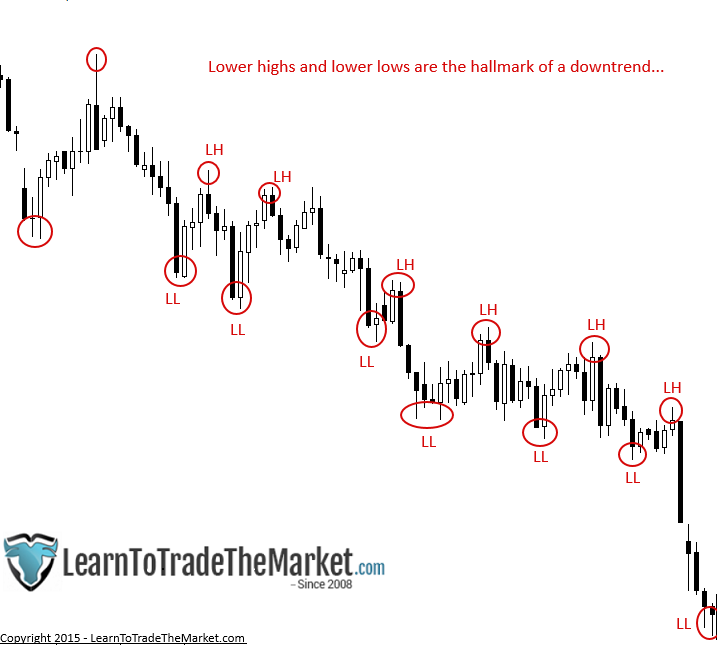
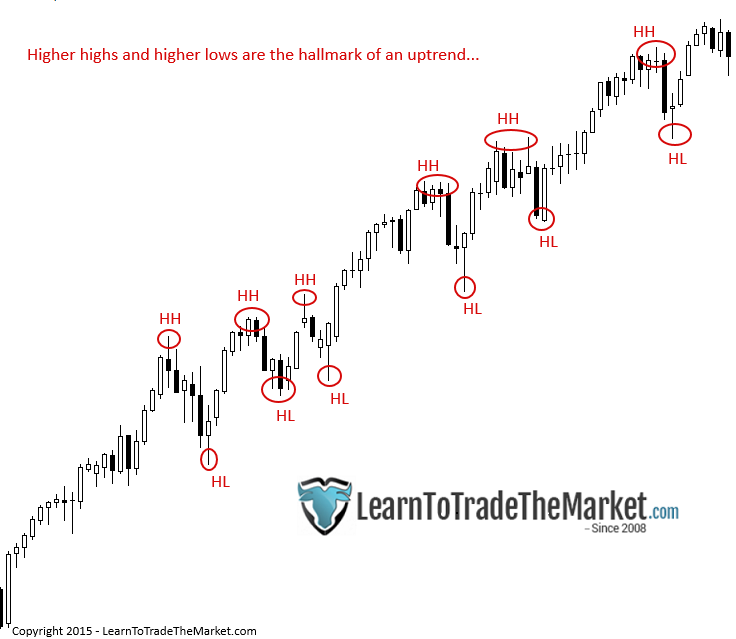
My favorite solution to decide if a market is trending or not, is to easily take a look at the worth motion of that market. Very merely, I search for a repeating sample of Greater Highs (HH) and Greater Lows (HL) in an up-trending market and Decrease Highs (LH) and Decrease Lows (LL) in a down-trending market.
Right here is an instance of a market that was clearly trending decrease as evidenced by the repeating sample of Decrease Highs and Decrease Lows…
Right here is an instance of a market that was clearly trending greater as evidenced by the repeating sample of Greater Highs and Greater Lows…
Tip – I typically get emails asking me how I do know when a brand new development has begun or an previous one has ended. Properly, you employ this identical tactic of searching for worth motion patterns of HH HL or LH LL. For instance, when you see a sample of HH and HL has been interrupted or damaged, by worth making a Decrease Excessive, it’s an early-warning that the uptrend could also be coming to an finish.
To really contemplate that the up-trend has ended and a brand new down-trend has begun nonetheless, we have to see at the very least one sample of LH and LL following the uptrend. Which means, as soon as worth makes the primary Decrease Excessive (so it fails to make a Greater Excessive), we’d then have to see it make a Decrease Low following that Decrease Excessive, at this level, we will begin trying to be sellers.
Search for parallel ranges
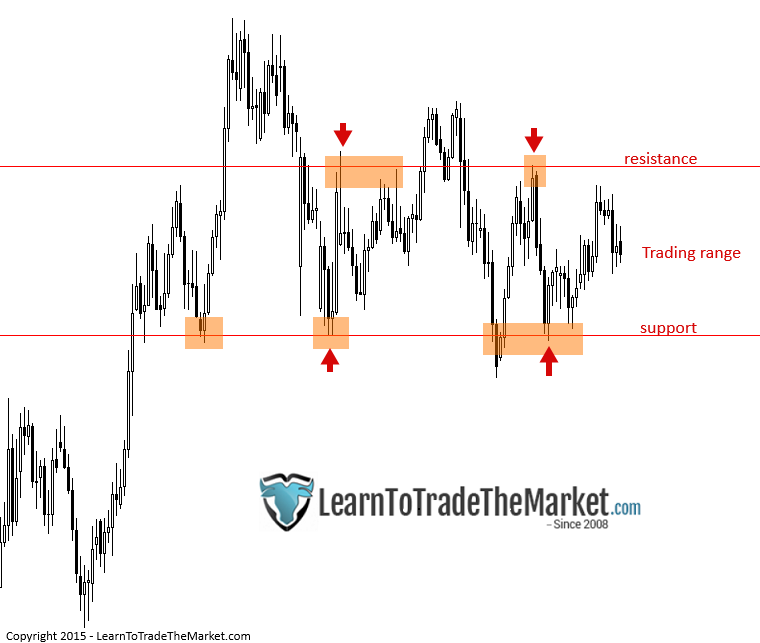
We will additionally use key ranges of help and resistance to find out if a market is trending or not. The essential method is to easily search for worth that’s clearly oscillating between parallel ranges. Whether it is bouncing between two parallel ranges, then you’ve gotten a range-bound or sideways market, not a trending market.
There are two primary kinds of sideways markets; a ‘uneven’ one and a range-bound one, for extra on this, take a look at my latest lesson on find out how to commerce a sideways market.
Within the instance beneath, we will see that worth was typically transferring sideways between parallel ranges of help and resistance. Discover that worth received’t at all times hit these ranges ‘precisely’, but when the final motion is sideways between two apparent ranges, you’ve gotten a non-trending, range-bound market.
Shifting averages
The subsequent tactic that we will use to differentiate a trending market from a non-trending market is using transferring averages. Shifting averages present a neater visible clue for newcomers, however they have to be utilized in mixture with the worth motion tactic mentioned in level one above, for causes I’ll talk about quickly.
I sometimes use the 8 and 21 day exponential transferring averages (emas) on the every day chart time-frame as a quick-guide for development in addition to dynamic help or resistance (worth) areas.
There are principally two issues to search for when utilizing transferring averages to differentiate a trending from non-trending market. One, is the path of the cross; are the transferring averages crossed up or down? I solely use the ‘crossover’ to find out path, I don’t use it within the conventional “transferring common crossover entry system” that some folks educate.
The second factor to search for is that if the transferring averages are diverging (transferring away) from one another, as that is indicative of a really sturdy trending market. Nonetheless, it is advisable to mix the transferring averages with the worth motion tactic from level one, as a result of transferring averages alone will generally idiot you if a market is vary sure. They’re actually solely used as a fast reference for development path and to see worth areas to look to purchase and promote from.
The ema’s themselves mark a dynamic (transferring) help and resistance zone or layer; the ema layer is the realm between the 2 ema’s, such because the ‘8 and 21 day ema layer’, and we will look ahead to worth motion indicators from this layer as worth retraces again to it, to commerce in-line with the development.
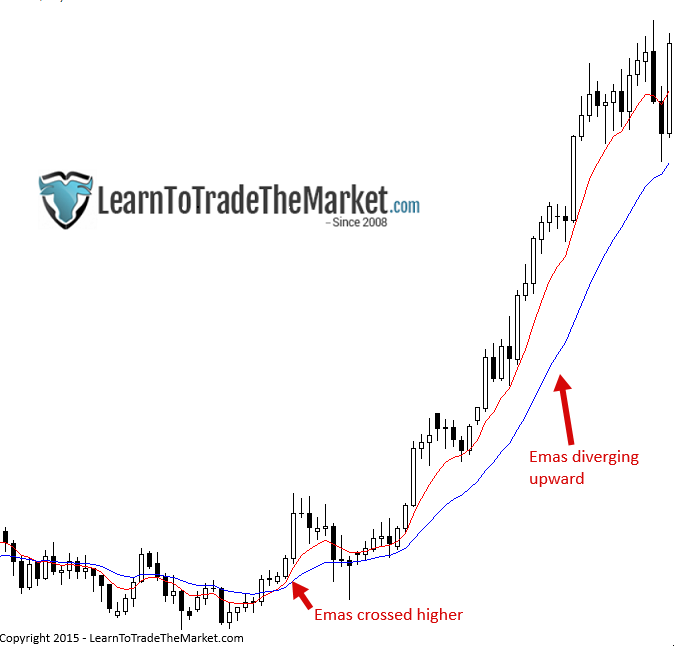
The principle caveat to utilizing transferring averages for development identification, is that in a range-bound market they’ll trick you. For this reason it is advisable to additionally use the worth motion technique I mentioned within the first level above, to behave as a ‘filter’ of kinds for the transferring averages.
For instance, in a variety sure market as described in level 2 above, should you put transferring averages in your chart, they are going to cross up and down as worth oscillates between the parallel ranges. So, should you observe the transferring averages in a range-bound market, you’ll constantly get whipsawed as worth will typically change path proper because the transferring averages cross. Because of this, I choose tactic 1 above, however the transferring averages is usually a good complement to that tactic and as I discussed, they’ll additionally present us with good ‘worth areas’ in a trending market to look to purchase and promote from.
Conclusion
The development is certainly your buddy, and also you need to be completely clear on whether or not a market is trending or not earlier than you begin attempting to commerce it. Hopefully, this lesson has clarified find out how to distinguish a trending from a sideways market, to be able to enhance your possibilities of catching large strikes out there. To study much more about buying and selling trending and sideways markets, take a look at my worth motion buying and selling course.