


Coinbase’s CPO has defended stablecoins and pushed again on the banking sector’s fears of a possible collapse of financial institution deposits and neighborhood banks, arguing that the issues are unfounded and will pose a threat to the rising sector.
Coinbase Refutes Banks’ ‘Inconsistent’ Claims
Because the stablecoin sector’s momentum grows, Coinbase CPO Faryar Shirzad has challenged the US banking business’s issues over potential dangers related to the rising digital property.
In an X put up, Shirzad affirmed that the continued narrative that stablecoins will destroy financial institution lending “ignores actuality” and misreads the second, as “quicker, cheaper, programmable transactions aren’t a risk—they’re overdue progress.”
A market observe from the Coinbase Institute, cited by the CPO, acknowledged that these arguments “echo acquainted worries from earlier improvements like cash market funds. But they fail to account for a way and the place stablecoins are literally used, and what they contribute to monetary modernization.”
As reported by Bitcoinist, the banking sector has criticized the Guiding and Establishing Nationwide Innovation for U.S. Stablecoins (GENIUS) Act for potential loopholes that would pose dangers to the monetary system.
The landmark crypto framework, which was signed into regulation in July, prohibits curiosity funds on the holding or use of payment-purpose stablecoins. Nevertheless, the prohibition solely tackles issuers and might be “simply circumvented” by exchanges or associates offering rewards.
In August, a number of banking associations throughout the US despatched a joint letter to the Senate Banking Committee urging Congress to amend the regulation. The letter argued that curiosity funds distort market dynamics and will have an effect on credit score creation, and prompt extending the prohibition on curiosity funds to incorporate digital asset exchanges, brokers, sellers, and associated entities.
Since then, a number of business gamers, together with Shirzad, have rejected these issues, stating that the banking sector’s proposals might threaten to create an uncompetitive surroundings for stablecoins.
Stablecoins Received’t Drain US Banks
Coinbase Institute outlined a number of explanation why stablecoins gained’t drain deposits from US banks and as an alternative will strengthen the worldwide function of the US greenback, introduce long-overdue competitors within the funds sector, and help new, extra environment friendly channels for credit score formation.
The market observe argued that stablecoin demand is international, with most present use coming from overseas and on-chain markets. They cited a current Atlantic Council report exhibiting that over 80 p.c of transaction quantity comes from worldwide customers searching for greenback publicity.
In the meantime, round two-thirds of stablecoin transfers happen inside decentralized finance (DeFi) platforms or blockchain-based fee rails. Coinbase added that USD-pegged digital property broaden greenback entry worldwide and reinforce its dominance.
In that sense, they’re the transactional plumbing of a brand new monetary layer that runs parallel to, however largely outdoors, the home banking system. (…) Subsequently, forecasts proposing that a number of trillion {dollars} might stream into stablecoins over the subsequent decade ought to be fastidiously scrutinized.
Moreover, Coinbase highlighted that banks have extra liquidity and have put out trillions of {dollars} of deposits in reserves and treasuries, suggesting that the sector has sufficient credit score slack to compete with stablecoins for a extra environment friendly monetary system. Subsequently, it might be “inconsistent to assert that stablecoin development poses a systemic risk.”
The market observe additionally emphasised that neighborhood banks are largely unaffected by the sector’s development, arguing that stablecoin customers and neighborhood financial institution prospects hardly ever overlap.
Lastly, Coinbase asserted that “Credit score is evolving, not shrinking. Lending is shifting to personal credit score, fintech, and DeFi channels that don’t rely on deposits. Liquidity strikes—it doesn’t vanish,” concluding that “treating this improvement as a risk dangers misunderstanding the transformative path of economic innovation and constraining an rising benefit for the USA.”
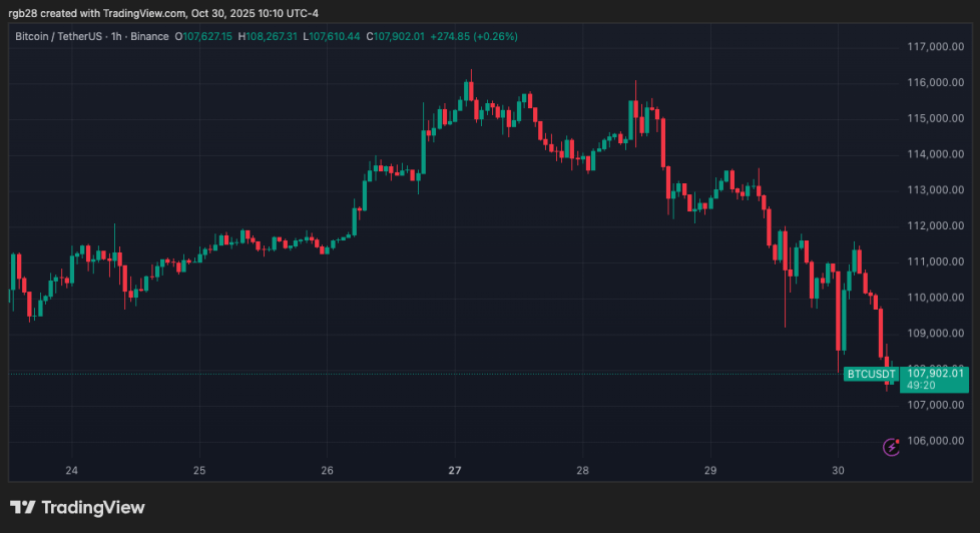
Bitcoin (BTC) trades at $107,902 within the one-week chart. Supply: BTCUSDT on TradingView
Featured Picture from Unsplash.com, Chart from TradingView.com
Editorial Course of for bitcoinist is centered on delivering totally researched, correct, and unbiased content material. We uphold strict sourcing requirements, and every web page undergoes diligent evaluate by our workforce of prime expertise specialists and seasoned editors. This course of ensures the integrity, relevance, and worth of our content material for our readers.

