

Be a part of Our Telegram channel to remain updated on breaking information protection
The UK would require home crypto exchanges to report transactions by native residents from subsequent yr because it plugs a spot in reporting guidelines.
The change will give the tax authority, His Majesty’s Income and Customs (HMRC), entry to home and cross-border crypto transaction knowledge for the primary time.
CARF To Roll Out In 2027
The change will develop the scope of the Cryptoasset Reporting Framework (CARF), a cross-border reporting framework that was developed by the Organisation for Financial Co-operation and Growth (OECD).
The framework allows the sharing of data between tax authorities worldwide, and would require crypto asset service suppliers to carry out due diligence, confirm person identities, and report detailed transaction info on an annual foundation.
CARF’s first world info trade is ready to happen in 2027.
UK Goals To Stop Crypto Escaping Widespread Reporting Commonplace
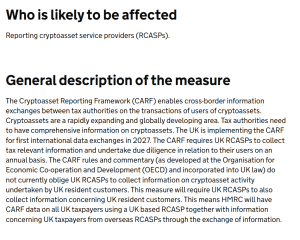
On condition that CARF is a cross-border framework, crypto transactions that happen immediately inside the UK would fall exterior of the automated reporting channels, in keeping with a coverage paper shared by HMRC earlier this week.

Description of HMRC’s new measure (Supply: UK Authorities)
The aim behind extending CARF’s scope to cowl home customers is to stop crypto from changing into an “off-CRS” asset class that escapes the visibility utilized to conventional monetary accounts underneath the Widespread Reporting Commonplace.
UK officers have additionally mentioned that by increasing the scope of CARF to home exercise, tax authorities will acquire entry to a extra full knowledge set to establish non-compliance and higher assess taxpayer obligations.
UK Proposes “No Positive aspects, No Loss” Tax Rule For DeFi
The reporting change and enlargement of CARF’s scope within the UK comes shortly after HMRC signaled assist for a “no acquire, no loss” (NGNL) strategy to crypto lending and liquidity pool preparations earlier this week.
At the moment, when a decentralized finance (DeFi) person deposits funds right into a protocol, even when it’s to monetize these funds or take out a mortgage in opposition to them, the transfer could possibly be handled as a disposal and set off capital positive aspects tax. The NGNL transfer might defer capital positive aspects tax till there’s a true financial disposal.
HMRC has printed its session final result within the UK concerning the taxation of DeFi actions associated to lending and staking.
A very attention-grabbing conclusion is that when customers deposit property into Aave, the deposit itself will not be handled as a disposal for capital positive aspects…
— Stani.eth (@StaniKulechov) November 27, 2025
In sensible phrases, the NGNL proposal might imply that customers who deposit crypto into lending protocols, or who contribute property to automated market makers, would not be taxed on the level of deposit. As a substitute, the tax would solely be utilized after they finally promote or commerce their property in a means that realizes both a acquire or a loss.
The proposal seeks to align tax guidelines with how DeFi really works. It might additionally assist cut back admin burden and tax outcomes that don’t replicate the financial actuality of some exercise that takes place within the DeFi house.
The NGNL strategy would additionally apply to multi-token preparations utilized in decentralized protocols, which are sometimes advanced. As an example, if a person receives extra tokens again than they deposited, the acquire can be taxed. Nevertheless, the transaction can be handled as a loss if the person receives much less tokens than they’d deposited.
Associated Articles:
Finest Pockets – Diversify Your Crypto Portfolio

- Simple to Use, Function-Pushed Crypto Pockets
- Get Early Entry to Upcoming Token ICOs
- Multi-Chain, Multi-Pockets, Non-Custodial
- Now On App Retailer, Google Play
- Stake To Earn Native Token $BEST
- 250,000+ Month-to-month Lively Customers
Be a part of Our Telegram channel to remain updated on breaking information protection

